Nigerian newspapers · 5 May 2020
Nigeria Faces High Risk of Venezuelan, Zimbabwean Crisis- Utomi
Nigerian news from AbokiFX Rate
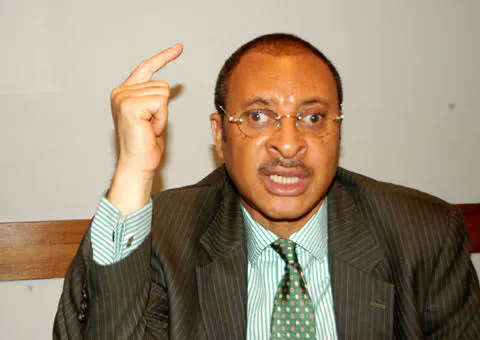
- "Naira on the way to N1000 per Dollar"
According to renowned economist, Professor Pat Utomi, Nigeria may just have saved itself from experiencing a Venezuelan, Zimbabwean crisis and a return to tough times in 1984 by seeking a $3.4 billion emergency funding from the International Monetary Fund (IMF).
The Professor said Nigeria was at such a crisis stage that it needed to keep borrowing to pay its dues, keep up with international transactions and have a running economy.
But for borrowing, he noted that the nation was on a downward spiral, on its way to experience the Zimbabwean situation of a dollar being equivalent to N1,000, a Venezuelan crisis of hyperinflation, escalating starvation, crime and mortality rates and a return to 1984 where Nigerians had to be on long queues to purchase essential commodities.
READ ALSO, Disaster Averted As Tankers Collide in Lagos
He attributed the current situation of Nigeria “begging” to borrow to the failure of the Nigerian government over the years to save money in a Sovereign Wealth Fund, but rather governors asking for more money from oil revenues as they come in.
Utomi noted that the nation’s economy sank into its current crisis as a result of lack of foresight of the nation’s leaders, maladministration, too many bad judgements, the penchant for free cash from oil and lack of conscious efforts to move the economy away from dependence on oil.
Notwithstanding the current compulsion to borrow, Utomi said it was imperative for the nation to be disciplined in utilizing the loan by cutting down on an over-bloated government.
“Borrowing is a complex issue. It is not good or bad; it is a matter of survival. Where you are, you can’t function at all, so you have to find something to keep you running.
“The reason the IMF was created is to respond to this kind of crisis. Every member of the IMF has shares there, of course, some have more than others. From those monies, the IMF has this special drawing right from which they can help the struggling ones.
VISIT ABOKIFX FOR LIVE RATES OF NAIRA TO DOLLAR
“When you get an adjustment loan from the IMF, you get certain conditions or behaviour. It’s those conditionalities that made the IMF very unpopular in the 70s when many war countries ran into structural problems. Nigeria ran into trouble, exactly in this same kind of situation that we have today.
“For two weeks in 1982, Nigeria could not sell one single barrel of crude oil and we ran into the kind of crisis we are having today and Nigeria needed to run to the IMF.
“There is a stage where you can’t help but borrow. You don’t have a choice right now. If you don’t borrow any money right now, you are dead as a country because you can’t pay for any of your dues, international transactions then you get to where Venezuela is; which is where we were in 1984 where you can’t find sugar, milk on the shelves. Back then in 1984, people were on a one-mile long in Lagos to buy one packet of sugar or essential commodities called essenco. Not to get there, you need to go through this kind of loans.
“But if you just get this kind of loan and you don’t get to the discipline of cutting the cost of government, cutting our coat according to our cloth, then we can go into a downward spiral, the kind of thing that Zimbabwe went through that at a point in time, what was one Zimbabwean dollar became equivalent to about one billion.
“What we have currently is an over-bloated government in which people pursue plunder economic rents in a matter that is preventing the ability to build an economy that is sustainable.
“If we don’t get this kind of loans to shore things up, the naira will get to about to a thousand,” Utomi said.
GET FINANCIAL NEWS AND UPDATES ON ABOKI FX
Amid post-COVID-19 consequences on the nation’s economy, Utomi said the current pandemic again offered the nation an opportunity to diversify away from its dependence on oil. This, he said should be done by the nation focusing on planning and identifying natural endowments which the nation is naturally competitive in and has a latent comparative advantage.
He particularly noted that the nation should focus on diversifying to agriculture to guarantee food security for the nation and provide millions of job for Nigerians. With businesses bound to experience shocks imposed upon them by COVID-19, he urged the government to trim down an over-bloated government to have an effective economy.
“This COVID-19 offers us an opportunity to diversify away from our dependence from oil. We need to do some planning, not in the communist centralized planning sense but we need to ask where are we going and how do we get there.
“My approach, through the years, is that we look to our latent comparative advantage, that is to say, we take a look at our natural endowments, where we are competitive naturally in. You can go to cassava, plantain, sesame seeds, cocoa and therefore say we want to dominate the global value chain in those areas.
READ MORE BREAKING NIGERIAN NEWS ON ABOKIFX
“Very often, you hear people say that the most redundant line in Nigeria’s budget speeches is, 'Nigeria is committed to restructuring away from its monocultural dependence on crude oil.'
Yet, at the end of every year, you will see that absolutely nothing of significance was done to consciously move the Nigerian economy away from this dependence.
The reason is that we have a lazy political class, whether soldiers or civilians, who see government simply as the terrain of plunder where they can go and make hay rather than where they can build immortality of their names in history as nation builders. So, they really have lacked the discipline to pursue this course.
“So, instead of feeling pity, I feel the joy that this may cause us to rethink everything and as we do this, we must come to the fact that we need to have a lean and trim but effective government.
ABOKIFX GIVES YOU EXCHANGE RATE TODAY
“Sometime last year, it was clear that Nigeria was going into a triple shock scenario. The first shock was from an increasing loss of confidence in Nigeria as an investment destination.
“You will recall late last year a Forbes magazine assessment that said Nigeria was a money-losing machine, that is, if you want to lose money, invest in Nigeria and it was really an attack on the regulatory risk of doing business in Nigeria. Government is the biggest problem of doing business in Nigeria.
“There was also the shock of oil prices already dropping before COVID-19 that by the time they were announcing the budget for 2020, oil prices were already below the projected price. And then, there is this story going around in Wuhan that there is something called coronavirus and it had the potential for a pandemic.
“In the middle of all of this going on that our economy was going to shut down, the National Assembly votes to buy themselves new luxury cars. In any normal country, they will stone such people in streets but we are not a normal country and the quality of our political class is poor,” Utomi said.
INTERESTED IN UP-TO-DATE CURRENCY CONVERSION RATES? VISIT ABOKI FX